
The challenge for today’s Chief Data Officer (CDO) has fundamentally shifted. It is no longer enough to focus solely on reports; modern organisations must build fluid, specialised teams capable of driving deep insight generation, providing robust decision support, and operationalising the latest technologies, including Decision Intelligence (DI) and advanced analytics.
Fragmented data teams, poorly defined roles, and a lack of clear governance are the biggest blockers to achieving genuine competitive advantage. Without a deliberate strategy for organising talent and technology, critical projects—from a simple reporting dashboard to an automated Generative AI solution—will stall early and frequently.
This blueprint outlines the three critical strategic pillars for structuring, staffing, and governing a high-performing data and analytics team fit for the era of Decision Intelligence.
1. Pillar 1: Re-imagining the Team Structure for Scalability
For large, complex organisations, relying on a single, centralised data team can create severe bottlenecks. A highly centralised team often struggles with slow response times and risks being out of touch with the specialised needs of individual business units.
The modern solution is a Federated or Hybrid Model. This structure balances corporate oversight with domain-specific agility.
- Central Core Team: This team maintains strategic direction and consistency. It sets overarching data policies, standards, governance, and technology roadmaps across the entire organisation. This ensures compliance and quality.
- Decentralised Domain Teams: Data professionals are embedded directly within individual departments (e.g., Marketing, Finance, Operations). This grants them deep, domain-specific knowledge, allowing them to deliver tailored, context-specific solutions faster.
The Data Mesh Evolution
This federated approach supports the principles of a Data Mesh architecture, where responsibility is distributed. Domain teams are empowered to treat their data as a product, ensuring it is discoverable, addressable, and trustworthy for the rest of the organisation. This structure inherently improves scalability, flexibility, and collaboration, allowing the enterprise to manage diverse data assets effectively.
2. Pillar 2: Introducing Specialised Roles for Insight, Automation, and Decision Intelligence
The skill sets required for a modern data team must extend far beyond basic SQL and dashboarding. Effective decision support and the deployment of advanced analytics, ML, and GenAI demand distinct, highly specialised operational roles.
A. The MLOps Engineer (The Automation Role)
The MLOps Engineer is crucial for bridging the gap between data science and IT operations. They apply DevOps principles—standardisation, automation, and continuous monitoring—to ML systems. Their primary focus is ensuring that advanced models move smoothly from development and testing into the production environment for automated decision intelligence.
Core Responsibilities Include:
- Automation: Building pipelines for automated training, testing, and deployment of models.
- Scalability: Containerising models and managing cloud infrastructure to handle large data volumes and high user traffic.
- Monitoring: Tracking model performance and data drift in real time, and triggering automated retraining if necessary.
B. The Prompt Engineer (The Language Layer UX)
The rise of Large Language Models (LLMs) has introduced the Prompt Engineer, a critical role focused on maximizing the performance and reliability of GenAI applications used for insight generation and decision support. This role sits at the intersection of language design, engineering, and experimentation.
Core Responsibilities Include:
- Designing and Testing Prompts: Building prompt templates and experimenting with phrasing to optimise clarity, safety, and task success.
- Aligning LLM Behaviour: Ensuring the model’s output aligns with brand tone, product goals, and domain-specific accuracy.
- Ethical Oversight: Monitoring AI outputs for biases or ethical issues and adjusting prompts accordingly.
C. The Foundational Roles
The core of the team still relies on established expertise, which is now explicitly geared towards actionable insight and decision support:
- Data Engineer: Builds and maintains the efficient data pipelines (ETL/ELT) that collect, clean, transform, and store data, ensuring it is prepared for analysis.
- Data Architect: Designs the organisation’s overall data strategy, blueprint, and governance standards, ensuring systems align with long-term growth objectives.
- Data Scientist: Designs and experiments with advanced analytical models, tests hypotheses, and provides predictive and strategic insights. Crucially, they are responsible for summarising complex data through reports and visual aids, ensuring that decision-makers across the business receive actionable decision support.
Pillar 3: Governing Data Assets with Accountability
Even the most talented team will fail without a formal governance programme to manage risk and enforce accountability. Governance moves beyond compliance; it is the strategic defence against data quality issues, security breaches, and ethical failures, ensuring the trustworthy data foundation required for reliable Decision Intelligence systems.
A high-performing team requires a clear structure of ownership:
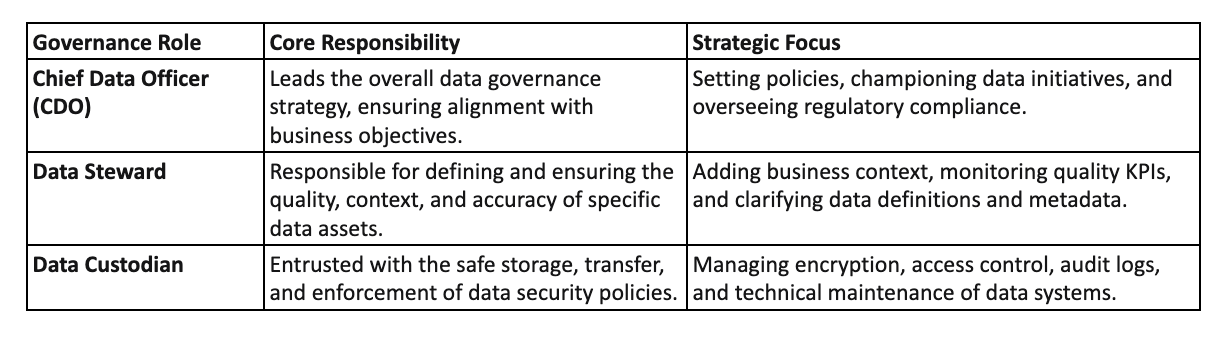
By formalising these roles, organisations can achieve crucial outcomes, such as creating a “single view of the customer,” standardising names across systems, and ensuring data used in regulatory reporting (like GDPR) is complete and auditable—all non-negotiable prerequisites for accurate automated decision support.
Conclusion: Actionable Next Steps
Achieving success in the modern data landscape requires leaders to stop viewing data teams as a cost centre and start viewing them as a specialised operational factory focused on insight generation and decision automation.
The three pillars provide the roadmap: adopting a federated model for agility, embedding specialised roles for advanced analytics and DI, and building a formal governance structure for trust. This comprehensive strategy ensures your team is equipped not just to report what happened, but to drive and automate what happens next.
Your next step is to audit your current team against this modern blueprint. Delaying this assessment exponentially increases your operational risk and slows your time-to-value from Decision Intelligence investments.